Author Archives: hisdesertrose

On His Shoulders — Nothing to Prove

Standard

The past year has been one of recognizing my own weakness.  And there is nothing like recognizing your own weakness to cause you to reevaluate your perspective on life.  I don’t like to be weak; I like to be strong.  I want to take care of everything and everyone else around me, making life run smoothly.  So I toil beneath the crushing burden of my own expectations of perfection, determined to be strong.

What boxes are you carrying?

What boxes are you carrying?

Yesterday, as I balanced an unwieldly jumble of boxes while attempting to open a door, a friend ran up to help me.  “I’ve got you, Sabra,” he said.  Assuming he was coming to hold the door, I readjusted the boxes in my arms, thanking him earnestly.  But when he reached to take the boxes from me, I was surprised.  He smiled and said again, “No, I’ve got you, Sabra.”  Such a brief encounter, such a simple kindness, yet I was undone.  Here I was, waiting for someone to hold the door when someone was willing and able to take my boxes.  As I considered this, I wondered how often I misunderstand Jesus like that, hoping He’ll hold the door when He really wants to carry my burden.  He’s standing here telling me, “I’ve got you, Sabra,” but I’m so busy being strong that my greatest expectation is for Him to hold the door for me.

I always liked the moment in Pilgrim’s Progress when Pilgrim laid his heavy burden at the foot of the Cross and journeyed onward, lightened and free.  Yet like all analogies, it has its shortfalls.  The Cross is not a moment we come to then move beyond; it is a grace we live out a daily basis.  Salvation is not a point in time; it is an eternal, ever-present reality.  It is indeed that first Jesus-encounter before the Cross that gives us full access to grace and relentless forgiveness.  However, learning to walk in that freedom takes both time and practice as the Holy Spirit works in our lives, renewing our minds and transforming our habits.  We must learn to live beneath a new yoke – not the self-inflicted burden of rules and failures and expectations, but the light load that Jesus offers.     

Come to me, all of you who are tired from carrying heavy loads, and I will give you rest.  Take my yoke and put it on you, and learn from me, because I am gentle and humble in spirit; and you will find rest.  For the yoke I will give you is easy, and the load I will put on you is light.
– Matthew 11:28-30 GNT

But why is the burden or “load” that Jesus gives us so light?  Why is His yoke so easy?  It is because He takes our burdens upon His shoulders.  That is what the Cross is: “Surely He has borne our griefs and carried our sorrows….He was bruised for our iniquities; the chastisement of our peace was upon Him, and by His stripes we are healed” (Isaiah 53:4, 5).  In light of the fact that pride causes problems but humility finds grace from God, we are urged, “Therefore, humble yourselves under the mighty hand of God, that He may exalt you in due time, casting all your cares upon Him, for he cares for you” (1 Peter 5:5-7).  God has not called us to lonely toil beneath heavy burdens of expectations and rules; rather, He has called us to sit quietly at His feet, finding our value in the restful place of His presence.  (Check out the Luke 10 account of Mary and Martha.)  He can faithfully promise rest because His shoulders carry the burden.

Jesus is our strong, steady companion who shoulders the load for us little oxen.

Jesus: our strong, steady companion who shoulders the load for us little oxen.

I had a cold this week, and on Thursday morning my mom essentially forbade me from going to class and chapel.  She told me that I needed to rest in order to regain my health.  “Sometimes it is just reality that you take a sick day,” she said.  Just reality.  I didn’t want that to be reality – I wanted to be strong.  It was difficult for me – I had to delegate my responsibilities and let other things go.  Last fall, considering my other commitments, I took on an obscene number of class credit hours.  When people mention that they barely saw me in the previous fall semester, I say that I barely saw myself.  My continued 4.0 GPA and high praises from work may not have made it seem as though I was struggling, but the reality of that situation is that I can scarcely recall anything from that semester.  Apparently my stress level was so high that my brain decided to blur my memories – and that makes me sad, because I missed out on the pleasures in my quest to be strong.  That same semester, I did not want to break down when my dog was put to sleep.  I felt embarrassment as I cried through a whole biology class.  (Of course, I would never have thought to skip the class that began minutes after I received the news about my pet.)  And even as I sought comfort from my closest friends, I wished my grief weren’t so messy.  I often find myself caught between the reality of my need and the depths of my pride. 

So you see, I write this not as one who “has it all together” (an unrealistic notion as ever was) but as one who is still learning to relinquish her boxes and let her Savior shoulder her weakness.  I am learning that my strength is not enough.  Though I knew it, it is another thing entirely to understand it.  Alone, I attempt to navigate an endless sea of expectations that I have for myself.  Yet like a shipwrecked sailor my strength soon wanes and I begin to sink.  I become so preoccupied with proving my strength, with doing everything perfectly, that I forget His yoke is easy and His load is light for me.      

I am not strong enough.  And that it is a healthy knowledge, because I have nothing to prove.  I want to be strong in His strength, and righteous in His righteousness alone.  I want to be a refuge and a resting place for others because I am at rest in His arms, safe in the shadow of His wings.  He has taken all my burdens upon His shoulders and simply waits for me to step into place and walk alongside Him. In His place of rest there is nothing to prove.  Our gentle Savior only longs for us to enjoy the spacious place of His gracious presence as He teaches us to operate in the freedom of His light load.

I’d like to share with you a song that I listened to as I wrote this.  Take a few minutes to listen to it; and as you do so, consider not only who Jesus is but also who you do not need to be because of who He is.  May we learn to find our place of rest at the side of Him who carries our every burden upon His mighty and unfailing shoulders.  We have nothing to prove, nothing to lose, and everything to gain.

“Shoulders” by For King & Country

It’s Not About the Swimsuit

Standard

Let’s talk about legalism.  It’s demanding, prudish, and ultimately ineffective, yet so many Christians get caught up in it.  I can define the entire legalistic Christian mindset with one example: swimsuits.  This is especially controversial when it comes to swimwear for girls: one-piece or two-piece?  Modesty or scandal?  Oh, the drama is endless!

I go to a small-town Bible college which I really do adore.  When we do school events that involve swimming, such as pool parties at a nearby YMCA, we wear swimsuits but, as I discovered, NOT two-piece swimsuits.   As it happens, two-piece swimsuits are not prohibited in the school handbook but apparently they are not allowed.  However, I was not told this prior to the party.  We were, in fact, only encouraged to wear our most modest swimsuits.  (I don’t consider any of mine immodest, but that’s blog material for another time.)  So, owning only two-piece swimsuits, and being a girl fresh from a missionary life of beach living on the Indian Ocean,  that’s what I wore.  A bikini.

After an hour of swimming, some of the girl’s resident hall staff suddenly realized that I was – gasp! – wearing a two-piece swimsuit.  Then, in the ensuing silence, with nearly a hundred pairs of eyes fixed on me, I was required to remove myself from the chin-deep water where I was swimming, and walk past everybody to get some sort of additional garment to put on atop my swimsuit.  Let me simply confess that in my indignation, I stalked away from the pool and didn’t come back.  I also considered delivering an impassioned soliloquy about injustice and the absurdity of legalism, but I would most definitely have said something regrettable. Anyway…

Long Beach, CA, 1937

Long Beach, CA, 1937

Something snapped in my spirit at that moment.  I was absolutely livid – though not for the reasons you might think.  First of all, I should have seen it coming.  I was the only female not wearing extra clothing over her swimsuit.  Then I felt hurt for a few moments – if there had been a real issue with my swimsuit, wouldn’t one of my friends have said something?  If there had been an issue, they certainly should have spoken up.  It wasn’t as if we all weren’t swimming together already!

But, you see, it’s not actually about the swimsuit.

I’d also like to make it clear that it wasn’t about my person.  Prior to the pool incident, some of the other girls had seemed surprised by my attire (I really should have known what was coming).  One of them said, “Well, if I were skinny like you, I would wear a two-piece and I wouldn’t care what anyone else thought.”  This deeply disturbed me.  As if being a smaller size was the sole validation for wearing a particular swimsuit!  This idea, too, was completely missing the point.  The fact that I am small-framed does not make it acceptable or unacceptable for me to wear a two-piece swimsuit.  The fact that another girl is larger-framed also does not make it acceptable or unacceptable.  If the only reason women choose two-piece swimwear is because they are vain or prideful about their bodies, it would be completely wrong – impure motives being the problem.  This post, then, is not meant to exalt or even recommend two-piece swimsuits, nor being “skinny,” nor any other sort of nonsense because those things are simply NOT the point.  One could easily look at this issue through any number of examples: what movies are appropriate, what music is fine to listen to, whether people should be allowed to wear jeans to church – the possibilities are practically endless.  Because, just as it is not about the swimsuit, it is not about size or shape or skin color or any of the external particulars that we might argue over.

I have always been a rule-follower, the stereotype “good girl.”  It comforts me to have a list of rules because I can follow them – oh blessed list! – and feel good about my appropriate performance.  My performance need not even face accusations, because I am always on the right side of whatever powers that be.

Now, as we get into this discussion, understand that when I talk about “rules” and “laws,” I don’t mean the obvious Biblical commands that we are called to obey (love your neighbor, do not steal, etc.) or the federal laws that we are bound to obey as citizens of our country (in accordance with the mandate of Scripture to obey authorities – for example, check out Romans 13:1-7).  I am talking about the gray areas of personal regulations or the other Christian-ese rules that we compile with the other laws we should obey, to make up a single, lofty list: “Requirements for Being a Good Christian.”

Here’s the thing: there is nothing actually wrong with this.  Scripture tells us to obey authorities, to follow rules, and to do what is right – all valuable and worthy goals.  There is a particular mindset, however, that often comes along with “good” rule-following.  The issue comes at the point when we cross over from obeying the rules to thinking that doing so will justify us – that is, legalism.  This brings up a question:

Are we acting as we do because we know it is right and we are showing love to others or merely because it is the law?

We have two major problems that become glaring when we look at legalism.  The first problem is that we tend to cling to the idea that we can “lead” people “into sin.”  But that really is a fallacy.  It is impossible to lead someone into sin.  You can tempt people by what you wear or say or by the choices you make, but it is impossible to “make” someone sin.  Consider the Biblical story of David and Bathsheba.  Obviously there was no room for excuses from David such as, “Well, she was taking a bath where I could see her from my roof, so I really couldn’t help myself…”  Clearly God would brook no such nonsense, and though David was angry that God sent a prophet to rebuke him, David knew his actions were wrong (especially considering he wasn’t out leading his army like he should have been).  (Check out 2 Samuel 11-12 to dig deeper into this example.)  Unfortunately, it is within the realm of Christendom and the Church that this “leading-people-into-sin” idea is most perpetuated.  The entire concept is both disgusting and extremely un-Biblical.

In response to that fallacy, we must realize that we were created for freedom, freedom to choose.  We should not think of this as freedom to do whatever we please but rather as freedom to choose what is right.  We are always free to choose what is right.  Romans 6:14 tells us, “For sin shall not have dominion over you, for you are not under law but under grace.”  Do you see what this is saying?  Christ gives us power to choose not to sin.

This is why it’s not really about the swimsuit itself – what we actually need to know is whether we females, by wearing our so-called scandalous two-piece swimsuits, are damning men to perdition by forcing them into the sin of lust (and other, darker things, as some might go so far to say).  Is it the swimsuit that does it?  It is the girl wearing the swimsuit?  Whose fault is the sin?  We struggle with the answers to those questions, and others like them, because we don’t really like to think about sin.

So we Christians seek to keep ourselves “safe,” not wanting to bear the guilt for causing anyone to sin – a most covert form of selfishness, because it is bound in a pretty wrapper of being beneficial to others.  You know, “Avoid even the appearance of evil” (1 Thess. 5:22) and all that important stuff.  In order to achieve this “safety,” we construct neat, tidy, towering walls of rules and regulations: no two-piece swimsuits, no shorts higher than the knee, no crazy tattooing, no movies that are over PG-13 (except the Passion of the Christ), no being alone with a member of the opposite sex, no, no, no, no, no….And thus we build ourselves a cozy, sure little bubble of things we can and can’t do, because if we follow all the rules, everything will be fine and dandy.  Or even if we don’t follow the rules, at least we know how to fast-track our way back onto the Heaven-bound path and get right with God: we simply have to follow the rules, a personal checklist to earning God’s favor….

Except that, too, is a lie, which leads into our second problemexternal controls (rules and laws and even other people) cannot change hearts.  No matter how many rules we follow, we can never change our hearts by simply obeying.  And not only can external controls not change your heart; they actually have no power to combat sin in your life!  Colossians 2:20-23 sums up the crux of the matter – which has nothing to do with which cut of swimsuit is appropriate:

‘Therefore, if you died with Christ from the basic principles of the world, why, as though living in the world, do you subject yourselves to regulations – “Do not taste, do not touch, do not handle,” which all perish with the using – according to all the commandments and doctrines of men?  These things indeed have an appearance of wisdom in self-imposed religion, false humility, and neglect of the body, but are of no value against the indulgence of the flesh.’

vintage signYou can make rules like the ones mentioned above.  You can swath women in fabric from head to toe, and you can take away every gun.  You can ban abortion and alcohol.  You can listen to only “Christian” music and demand that everyone else do the same.  But none of these things will stop people from sinning.  In fact, rules (even well-meaning ones!) are incapable of stopping sin because they only regulate actions or modify behavior.  Wrong actions are the result of sin, but sin actually begins as a heart problem: dark thoughts, fleshly desires, wayward emotions.  The nature of humanity has been tainted by sin since Adam and Eve made bad choices in the Garden of Eden; and our sin nature, the longings of our flesh, can’t be defeated by the external controls of laws.  These laws appear to be right – noble, even – and yet, as we saw in the Colossians passage, they “are of no value against the indulgence of the flesh”!

Rules can’t set us free from the power of sin.  Until people have an encounter with the living Jesus, their hearts will never be changed.

You might be protesting my strong stance on this.  After all, according to Romans 14 and 15, we shouldn’t put “a stumbling block or cause to fall in our brother’s way” (14:13); we should walk in love and bring peace, not causing grief for our fellow believers by our actions (14:14-23); and we should bear each other’s burdens and seek the good edification of other believers (15:1-2).  Also, following the previously-quoted section of Colossians, there is the admonition to clothe ourselves with godly ways (the “new man” we have through Jesus Christ) and live in love and peace with fellow believers, helping each other grow spiritually (3:12-17).  This is all poignantly true.  We ought to behave with love toward others, which means not doing things that we know will harm them (even if we think those things are fine) or cause them to struggle and stumble (because that would not be loving).  If any of my guy friends had said that my swimsuit made them even the slightest bit uncomfortable, out of love I would have stopped swimming or found another garment to wear and made things right so that they could be well.

But there is another side to this, and that is what I am trying to illuminate without disregarding the need for treating one another with godly love:

Rules are not love.  If rules had been enough to make love manifest, we would not have needed Jesus to set us free from sin and bring us into right relationship with Father God.

Rules can be good, helping keep us safe and promoting order.  Humans are sinful, and because not everyone is walking in God’s ways, we need to have those external controls.  But I will say again: rules are not love.  Showing true, godly love and consideration for the people around us does not mean keeping a long list of unyielding rules.  Following all the “right” rules cannot, in and of itself, display the love of Christ or truly help anybody.

Though we often have good intentions, using external controls to force a certain result is like keeping something dangerous locked up in a cell: no matter how well-guarded that evil thing is, there is always the possibility that it might escape.  As a Bible college attendee, I have noticed that life at school is somewhat of a bubble where we make rules to help keep people out of trouble and free from temptation to sin.  The problem is that the bubble isn’t real life.  In real life, guys are going to see girls on the beach in two-piece swimsuits.  And when they do, how are they going to react if they have been conditioned that any display of skin is wrong because it will sexually charge them to the point that they have no control and are “led into sin”?

We have a tendency to spend so much time removing temptations that we forget to teach our brothers and sisters in Christ how to deal with temptation victoriously Because of that, we hear so many stories about pastor’s kids (or the pastors themselves), Bible college students, and other “good” Christians choosing to tear their lives apart with sin.  Think about it: if the basis for our actions rests solely in the law, what happens when we come out of the little bubble of our local churches or Christian friend groups (or our Bible college campuses)?  Well, suddenly those external controls are gone, and, with nothing to control you anymore, you run willy-nilly into all manner of darkness and delusion.  Why?  Because external controls remove the need for internal responsibility if we become too comfortable – after all, we are creatures of comfort who would rather not expend any unnecessary effort.

Our focus has been so wrong, because it isn’t about the swimsuit or the person or any of those other external things – it’s about the sinfulness of human nature.

Our sin nature is dangerous and evil, so we seek to lock it up behind a wall of rules, restrained by shackles of law – yet in the end, it is we ourselves who end up shackled by the law and trapped in a prison of rules that can only point out our flaws.

But then there is Jesus.  His statement from the cross that ‘“It is finished”’ (Jn. 19:30) declared His triumph over the powers of sin and evil – it was a statement of completion, a sweeping victory that could not be reversed. When you allow the saving power of Jesus Christ into your life, becoming His, your sin nature is put to death (Gal. 5:24).  It is not merely kept in a dungeon somewhere, leaving you with the lingering fear of its escape; it is utterly destroyed!

Then, by the power of His Holy Spirit at work within you, you come to a place where you do not need external controls to help regulate your actions, because your heart is in the right place.  When your heart is in that right place of relationship with God, you will not need the safety net, the “bubble” of external controls because the Holy Spirit (sometimes called your conscience!) is your internal control.  As Christians, we are called to walk in the Spirit (in step with the Spirit, doing the things of the Spirit) because we have been made alive only through the life of the Spirit (Gal. 5:25).  We are meant to victoriously live out that which Jesus Christ’s death has already won – not because we are strong on our own, but because His Spirit is strong within us (check out Colossians 3:1-5).

1920's swimwear via Pixgood

1920’s swimwear via Pixgood

Ultimately, external controls are not God’s best – freedom is God’s best.  As I mentioned earlier, true freedom is not the ability to do whatever you want but rather the power to choose what is right.  In the end, external controls such as rules can help us regulate our actions or modify our behavior, but they can never be a substitute for the internal responsibility prompted by a heart that has encountered Jesus and been forever changed.

Here at the end of this passionate call to let the Holy Spirit be our guide, I have just two more things I want to mention.  Firstly, I have now purchased a two piece swimsuit with a full-length top so I can honor even the implied rules out of respect for those in authority at my school.  Secondly, I have now also been chosen to be part of the resident hall staff in the girl’s dorm, and I sometimes need to have discussions about what attire is appropriate – and I have times where I need to enforce certain standards.  And in all this, I can’t say that rules are always right or always wrong, and I can’t say that I think two piece swimsuits always good or always bad.  It is not and never has been about the swimsuit, about me, or even about rules.  I desire to promote a culture of honor and grace everywhere I go, and I can only do that when I allow my life to be intimately transformed from the inside out by Jesus.  No matter how silly or even twisted the issue at hand, making space for grace is always the right choice.  Every one of us is learning how to walk in greater freedom and greater love with our Savior by our side.  So be released to live in the spacious place of God’s grace that comes with allowing His Holy Spirit to be your internal control, and journey well, my dear friends!


Howzit?

Standard

While living in South Africa my family was frequently greeted, “Howzit?”  This catchy little phrase is a condensed version of “how is it going” – and “howzit” just rolls off the tongue so much more smoothly!  I find myself still using this colloquialism often, although I try to avoid confusing people with my quirky multi-cultural habits.

Don't settle for the mask of "fine."

Don’t settle for the mask of “fine.”

“Howzit” is a tiny phrase for a deep question.  Unfortunately, we tend to use the “how’s-it-going” bit as a casual greeting in passing.  Somehow, we manage to make a very intimate question into a phrase of mere utility.  And though the way we ask it might imply a distinct lack of care for the person we are asking, the ubiquitous and universal “fine” responses we receive are far worse.  Within the Church, we often perpetuate – unknowingly, perhaps – the idea that, once you have met Jesus and accepted Him as your Savior, you enter an even-keeled, continual state of “fineness.”  We somehow draw the conclusion that, because Jesus is our Restorer, our lives shouldn’t be messy and we should always be “okay.”

We act as though God is bothered by our humanness. But the truth is that life is messy.  Sometimes it is lovely, sometimes it hurts, and sometimes it just seems “off.”  The trouble is that we are bothered by our own humanness – and the humanness of others.  Because of this, as the Church, we have a tendency to settle for that “all-is-well” mien.  And when we do that, we end up with “fine” relationships, “fine” lives, “fine” families, and “fine” jobs – a whole world of false fineness built as we hide our messes or complacently slide through the cracks of fellowship.

People who ask me how I am faring will get an honest answer, and I’ve found that responding to (most) people’s flippant inquiries with anything other than “Fine” or “Well” makes them rather uncomfortable.  It is most frustrating to me, however, when I ask that question and receive the ubiquitous response of “fine” when I know that someone is not fine.  When I ask, I ask because I care, I want to know, and I want to do something about it – even if that “something” is just listening.  When people tell me they are fine but I can see the agony, the confusion, or the frustration screaming silently from their eyes, I am not okay with that.  I am not okay with letting people slip under the radar, unnoticed and solitary.  I am not okay with letting people be “okay” – whatever that means.  When “fine” is not actually fine, I am not satisfied.

The Body of Christ – the Church – is meant for so much more than “fine” and Sunday-pretty façades.

Time in fellowship is always time well-spent.

Me and two of my best friends, enjoying the night stars and each other’s company. Time in fellowship is always time well-spent.

As the Church, when we settle for “fine,” we are preventing ourselves from experiencing the wholeness and intimacy of fellowship within the Body of Christ.  Suddenly, in our “fine” lives, there is no chance to bear one another’s burdens (Gal. 6:2; Rom. 15:1-6) and no opportunity to do good to our fellow believers (Gal. 6:10).  We close ourselves off from allowing ourselves to love and be loved in a way that fulfills the law of Christ (Gal. 5:14).  We cannot “comfort…and edify one another” (1 Thess. 5:11) or bear with one another in love and enjoy unity in Christ through the Holy Spirit (Eph. 4:2-6).  And if we cannot do these things, we are not truly living as the Body of Christ. 

You see, in the Body of Christ, when one suffers, all suffer; and when one rejoices, the others rejoice in unison (1 Cor. 12:26).  In the Body of Christ, we are safe to confess our sins and embrace the fullness of God’s forgiveness (1 Jn. 1:6-9).  Within the Body of Christ, there is a beautiful cycle of giving and receiving that should be occurring.  It is in this place of fellowship and honest intimacy with Christ and each other that all our needs are met.

Don’t settle for “fine.”  We were not created for “fine” but rather for all the highs and lows of being humans with a good, good God who never fails.  Do not fear your humanness, for you were created in the image of our matchless God, to reflect His glory.  Choose vulnerability and find the wholeness you were meant for within the Body of Christ.  Journeys are best taken in community, so let us journey well and journey together, my friends!

Fellowship of the Ring

Life is a journey — take companions!

The Truth about Fairy-tales

Standard

thought about Disney's FrozenA friend shared this picture on Facebook right about the time Frozen came out.  I have now watched the movie, and it tweaked my brain into thinking about some very interesting concepts.  For instance: being independent and without responsibility doesn’t constitute freedom; true freedom comes with relationship and loving.  But back to the point of what this image says.  The whole idea that women don’t need men actually started with Brave.  Deviating from their well-known fairy-tales, Disney’s message in Brave was, essentially, girl power – women are powerful, men are fools, and we don’t need each other.  (Yes, I was really disappointed, to say the least.)  There also seems to be this idea floating around that fairy-tales are “out” because they just aren’t applicable to “real life.”  But let me tell you that those are lies, and when I say that, I am completely serious.  Let me tell you why:

Fairy-tales are straight from the heart of God.

Now, before you think, “That is ridiculous,” allow me to explain.  There is nothing more “fairy-tale” than the Bible, the story of God’s passionate love for His people.  The idea of this fairy-tale love, this perfect, selfless, eternal love, is woven throughout the Scripture.  That is in fact the very foundation of God’s Word.  You think I am kidding?  There are whole books of Scripture devoted to portraying that love – Hosea and Song of Solomon, for starters – and God Himself is love (1 John 4:16).  By definition “fairy-tales” are something intended to deceive people, albeit in a pleasant way.  Why would fairy-tales be deceiving?  Because surely life can’t actually be like that….Or can it?  Fairy-tales are based on ideals, not on what is but on what should be and could be.  That is how God sees the world He made.  He sees what is but He longs for what should be, for His best plan to be manifest in the earth.  As Christians, we are enabled to see not only the one-dimensionality of life as it is but the fullness of life as it should be.  This is our view into eternity through the flawless lens of God’s goodness.  That is why recognizing the Fairy-tale Heart of God is so important.

Still, that is not the only facet of God’s Fairy-tale Heart.  Our so-called “fairy-tales” survive because, like any other lasting story, they have at their core a thread of truth.  Fairy-tales picture ideals for the roles of men and women, but I want to tell you that those are not just make-believe; they are part of God’s plan for every man and woman He has created.  Understand that we are not looking at the damsel in distress and the cocky hero as models; we are looking at the beautiful princess and the mighty warrior, because they display God’s heart for the roles of men and women.  This is not just about “falling in love” or some romantic fluff.  This is true for every man and every woman.  The gift of nurture and loveliness is ingrained in every daughter, the gift to empower the men in their lives to be strong and the women to walk in the gifts that bring the life and love of God into everyday situations.  The gift of strength and adventure is ingrained in every son, the gift to fight with boldness the battles that need to be fought, guarding the women in their lives with their strength and reminding the men to be strong and courageous.

I do not write this to promote fairy-tales, nor do I write blithely, pretending that every aspect of man-made fairy-tales is good for us to emulate.  Rather, I write for this reason: Every daughter is a lovely princess and every son is a mighty warrior.  To deny that is to deny the deepest God-breathed questions and longings of our hearts.  Do women have strength?  Of course.  Can men be nurturing? Most certainly.  But this is the deep attraction, the reason men and women need each other, not simply romantically but as friends, as brothers and sisters in Christ.  God created men and women to each bear a unique part of His image, and that is nothing to be ashamed of.  Instead, we should delight in it and use that knowledge to build one another up.  (Not sure about this?  Check out the books Wild At Heart and Captivating by John and Stasi Eldredge – they are eye-opening and will change the way you look at the sons and daughters around you and the way you see yourself.)

Why, then, I asked, is the fatal lie being spread that men and women don’t need each other?  This is what God whispered to my heart:

“People are rejecting My Fairy-tale as a deception.”

Can you feel the heart of God breaking in those words?  My own heart broke when He said it.  We are giving in to the lies and the brokenness; we are giving in to the pain of ruined relationships by putting up shields around our hearts and declaring that the masculine and the feminine have no place together, that we stay strong by staying separate (though we prefer the word “independent”).   But this is the fear talking; all we are doing is attempting to avoid experiencing further pain.  As Wesley told Buttercup in The Princess Bride, “Life is pain.”  Fairy-tales are not meant to deny that life can be painful but rather to show us what should be and can be.  Pain allows us to see new depths of love.  If we deflect the pain, we deflect the love as well.  Let us embrace with abandon the Fairy-tale Heart of God, who has lavished His matchless love upon us, His Beloved Bride.  He is alluring you; can you not hear?

“The Lord your God in your midst, the Mighty One, will save;  He will rejoice over you with gladness, He will quiet you with His love, He will rejoice over you with singing.”  (Zephaniah 3:17)

heart“There is no fear in love; but perfect love casts out fear, because fear involves torment. But he who fears has not been made perfect in love.”  (1 John 4:18)

Live Wild

Standard
Leopard's Leap at Oribi Gorge, South Africa - 2010

Leopard’s Leap at Oribi Gorge, South Africa – 2010

Fear is a peculiar thing.  It compels us to avoid “risk” and idolize so-called safety.  I had never thought of myself as a fearful person until I realized that I was allowing my life to be completely ruled by fear.  It was not a fear of heights or darkness or strangers; rather, it was a fear of not being in control.  Until my family moved to Africa in 2009, I had no idea that, in the quiet steadiness of my young life, I had never really had to give God complete control.  I was so un-free in my carefully controlled life that it pains me to think of it.  Yet, at the same time, I look at where God has brought me now, and I smile for all He has done in me.

Despite being someone who has moved twenty or so times, lived in multiple countries, and done all sorts of fascinating things, I never really liked adventure.  To my mind, “adventure” was synonymous with “uncertainty” – and that was something I couldn’t bear.  Adventure meant risking trust because I can’t be in control.  Adventure meant that things might be different than I’d hoped or planned.  Adventure meant adaptability.  And if I was one thing, I was unadaptable.  Was.

Now I can confidently and joyfully say that I love adventure.  It is still scary sometimes in that it holds the possibility for so many unknowns, but I am safe in the hands of the One who knows all.  Adaptability and flexibility are things I have been learning relentlessly over the past few years, and many of these moments have been exhausting and difficult for this list-loving, plan-making girl.

Lion kisses at the Lion and Rhino Park in South Africa

Lion kisses at the Lion and Rhino Park in South Africa

I still have those moments where I think I just can’t cope with not knowing precisely where this adventure will lead me – I even had some moments earlier this week!  But now that I have had a taste of this freedom, there is no going back.  I will live out this adventure with passion, my eyes fixed on my Lord, or I will not do it at all.  I can’t do it alone; I need the joy of the Lord to be my strength, and I need Him to be strong where I am weak.

A few weeks ago I told God, “I feel like I jumped off a cliff, and I can’t see the bottom.  Please catch me!”  And God in His gentle way replied, “Sweetheart, you never left my Hand.”

“The eternal God is your refuge, and underneath are the everlasting arms…” – Deuteronomy 33:27 NKJV

I am discovering more each day that adventure is never a risk with God because He is both wholly sovereign and wholly good.  A life of adventure is not a life of ease – it is not a place for clinging to false security but rather for recognizing the trustworthiness of my God.  God alone is my safe place, and in Him I am free to live wild and love well.  He has freed me to fearlessly embrace the fullness of the adventure He has called me to.

In Christ, our freedom is given all at once but lived in over time.  It is the way of every great victory that the victors must learn to live in the fullness of what they have attained.  All too often we act like we are still captive to the fears that we were in before Jesus.  But that is the key: before Jesus.  Once we have received Jesus as our Lord and Savior, we are set free by the redeeming power of His blood.  This freedom is not merely a release from our sin nature; rather, it is an invitation to live in the fullness of the victory He has already won.

Ready for some fun on the ropes course with my cousins!

Ready for some fun on the ropes course with my cousins!

I went on my first zip line recently, but it didn’t seem very zippy – or very high.  It definitely needed more adventure.  I am laughing to myself as I contemplate this – I, the girl who was once unable to cope with unplanned situations, have become a lover of adventure with a desire to seek new things.  I still have much to learn about walking in this kind of freedom, but I am enjoying noting the outward manifestation of true heart-transformation.  The victory of Jesus at the Cross was total; fear and cowering no longer have a place in my life.  I am learning to be a thrill-seeker in the best sense, because, deep within my spirit, I know the truth is that there is only One who is wild enough to satisfy my craving for adventure.  Imbedded in the very core of who we are is an unquenchable longing for adventure because we are made in the image of our God, and our God is a God of adventure.  So no matter how diligently we try to squelch it or how wrongly we try to satiate it, our longing can only be satisfied in the One who is adventurous by nature.

Rich Mullins said, “God is a wild man.”  He went on to say that most of us would prefer a tame God who would always do the expected. But then again, that would be terribly dull – and terribly unlike the amazing nature of our God.  There is a difference between “wild” and “crazy.”  God is wild because He is untamable – utterly unconquerable.  Living adventurously is about living wild as our God is wild – not about doing crazy (i.e. dumb, thoughtless, insane) things.  Our God is a God of adventure, and He is calling us into a Great Adventure with Him.  Adventure is about a process – it is about the doing and the going.  To be fixated simply on “getting there” is to miss out on the beauty of what God is doing now.  We are called to live lives that are as wild and limitless as our God.

May His kindness release you to live wild and love well.  Be free, my friends!

If there is anything that has taught me to be flexible, it is being in the Teacher Education program. Thanks to Rachelle, my amazing professor for two years, who showed me every day how to embrace all the lovely, random moments.

If there is anything that has taught me to be flexible, it is being in the Teacher Education program. Thanks to Rachelle, my amazing professor for two years, who showed me every day how to embrace all the lovely, random moments.

Through Fire and Stillness

Standard
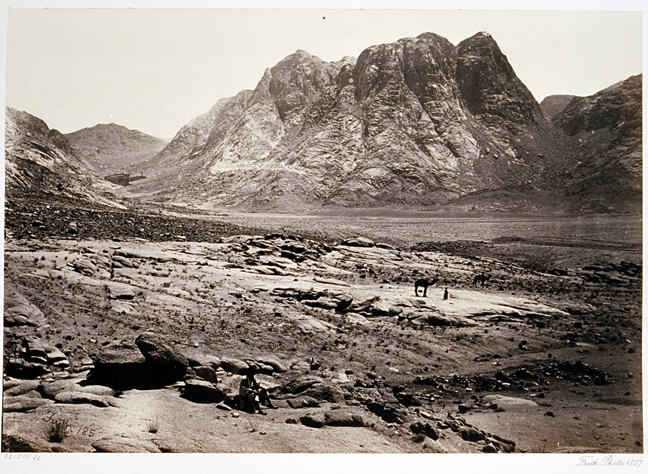
Mount Horeb, as captured by Francis Frith in 1857

Mount Horeb, as captured by Francis Frith in 1857

‘Then He said, “Go out, and stand on the mountain before the Lord.”  And behold, the Lord passed by, and a great and strong wind tore into the mountains and broke the rocks in pieces before the Lord, but the Lord was not in the wind; and after the wind an earthquake, but the Lord was not in the earthquake; and after the earthquake a fire, but the Lord was not in the fire; and after the fire a still small voice.’ – 1 Kings 19:11-12 NKJV

This is such a beautiful passage of Scripture to me.  The Lord spoke to Elijah not through fearsome power but through gentle quietness.  Yet sometimes I think we over-emphasize the stillness and forget that our awesome Lord speaks in other ways as well.  When we focus on only one aspect of His voice, we can inadvertently fail to hear Him speaking by other means.

As I read through 1 Kings again, I was fascinated to realize that the chapter prior to the story of God speaking to Elijah on the mountain, God “spoke” (revealed Himself) in a very different fashion.  Elijah was in a showdown with the pagan priests to determine whose god was all-powerful: Baal or the Lord God.  Elijah told the priests of Baal, ‘“Then you call on the name of your gods, and I will call on the name of the Lord; and the God who answers by fire, He is God.”  So all the people answered and said, “It is well spoken.”’ (18:24)

The scene was set; the water-drenched altars and sacrifices were prepared.  The idolatrous priests had their chance to validate the power of their god, and the answer they received was the only one a non-existent god could give: nothing.  Then Elijah called upon the Lord to send fire to prove His sovereignty.  How did the Lord answer?  Through fire, of course:

burning wood‘Then the fire of the Lord fell and consumed the burnt sacrifice, and the wood and the stones and the dust, and it licked up the water that was in the trench.  Now when the people saw it, they fell on their faces; and they said, “The Lord, He is God!  The Lord, He is God!”
– 1 Kings 18:38-39

In one chapter God speaks with fire and in the next chapter He speaks with a still, small voice.  Both times it is Him who is speaking – Scripture tells us it is so.  God was speaking what people needed to hear, in the way they needed to hear it, when they needed to hear it.  The people on Mount Carmel needed to God to speak through the force of fire – and they recognized that He answered their inquiry by sending it.  As the opposition-weary Elijah waited on Mount Horeb, having fled the wrath of a wicked queen fixated on his destruction, God spoke through a gentle whisper.  I’ve always wondered if God did that because He knew that Elijah needed to be reassured and comforted rather than awestruck by another display of power.

God loves to remind us that there are many facets to His nature, and He enjoys doing this by speaking to us in different ways.  Think of Moses before the burning bush (Exodus 3), Gideon hiding in the winepress (Judges 6), young Samuel in the temple (1 Samuel 3), the priest Zacharias longing for a son (Luke 1), or Saul on the road to Damascus (Acts 9).  Each account of God speaking is so unique yet, at the same time, so very Him.  There was never any doubt that God was speaking.  Scripture is rich with the voice of God.  The Bible is not only the Story of God speaking to humanity; the Bible is God speaking to humanity.  Every part of Scripture is given from His heart that we may know Him.

The point, my dear friends, is not whether He speaks through fire or stillness – the point is that He speaks and continues to speak.

I have had the privilege to edit and write a children’s ministry curriculum about the many ways God speaks to us.  The variety of means He uses to speak to us is as limitless as He is, and I have captured only a few – and those only in broad strokes.  One of the things I emphasize both in writing and teaching about this subject is simply this: God speaks.  He has spoken, is speaking, and will continue to speak because He never changes.  Just as He did in the Bible, God speaks to us what we need to hear, in the way we need to hear it, when we need to hear it.  Our responsibility is to be listening, seeking His voice.  As my daddy has told me many a time, “God is always speaking; we’re just not always listening.”

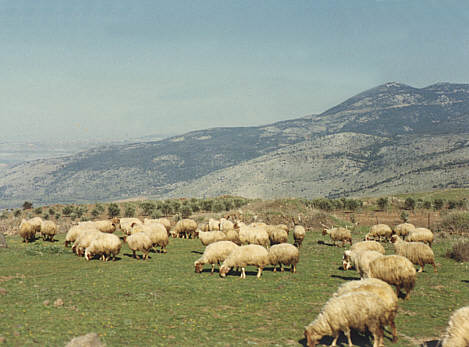
sheep in IsraelHearing God’s voice is vital.  After all, a relationship is impossible without good communication.  Jesus is our Good Shepherd, and we are His sheep (John 10:11, 14).  And our Shepherd has said that His sheep ‘“know his voice”’ (John 10:4), and He also said, ‘“My sheep hear My voice, and I know them, and they follow Me”’ (John 10:27).  This means that I know God’s voice; it means that you know God’s voice.  We never need to wonder if we can hear God’s voice, nor be afraid of not recognizing His voice.

And so I bless you to remember that God, who speaks through gentle whispers in the stillness, also speaks through fire.  He is tender and loving, but He is also fierce and mighty.  The focus is not so much on the means of revelation as it is on the fact that He speaks.  May you know His voice more intimately day by day, trusting both His words and His ways.

In Remembrance

Standard
Did I mention that I need a new journal?

Believe me, I am well aware of the blessing that is digital storage, which holds the hundreds of other pages full of my writing.

I love words, and I love to write.  I journal nearly every day, keep at least two notebooks at all times (one for ideas and one for regular things like lists), and am never without a diligently-tended planner.  I enjoy taking hand-written notes in class and jotting brilliant thoughts on my ever-present pad of Post-it notes.  The inside cover of my Bible is thick with sticky notes, and the margins of its pages are full of cross-references and revelations that have come to me as I read.  (Not to mention the unwieldly jumble of papers I stash near my bed, full of ideas for more writing, children’s church lessons, sermon notes…)

Yet, in all this, I write for just one reason: to remember.

I write so I can remember all the things God speaks to me, all the things I’ve learned and experienced – and how the sweet kindness of my God is evident through it all.  I have to write, because if I don’t, I know I’ll forget.  And I don’t want to forget.

As humans, we are so prone to forgetfulness: we forget to take out the trash, forget the birthday of a friend, forget an appointment, forget what day it is, forget what road to turn on, forget what we are forgetting….We just can’t seem to remember everything, no matter how hard we try.  Sometimes we even do things to try to forget: don’t think about it, throw mementos away, drown ourselves in unhealthy addictions to movies or drugs or anything else that will take away the pain of remembrance.  We get lost, be it purposefully or unintentionally, in the deep shadows of forgetfulness, allowing memories and thoughts to grow musty.  The weight of the past, the confusion of the present, the uncertainty of the future – when all these things seem to press in on us, sometimes forgetting feels easier by far.

But Jesus knows our weaknesses, our forgetfulness and our desire to forget.  He calls us out of our place of forgetfulness into the brilliance of remembrance from the place of His peace.  Our “humanness,” though it may bother us, does not bother Him.  He gives sufficient grace to us, His forgetful yet beloved Bride.  That’s why we have the Holy Spirit: to help us remember everything Jesus said (John 14:26).  It’s also why He charged us to take Communion “in remembrance” of Him – He didn’t want us to forget all He has done, all the love and life He freely offers (Luke 22:19).  He prods us gently, “Remember, remember Me!”

And so I write to remember.

I want to remember all His goodness to me.  I want to remember His tender words, spoken exactly when I needed them.  I want to remember every “aha!” moment of revelation.  Often I forget and have to remind myself of the things my faithful God has already told me.  When this happens, I can read through old journals and old blog posts – and I can remember.  Maybe writing isn’t your way to remember – maybe its songs or pictures.  While we do not need to construct physical altars to worship our God anymore because every barrier has been broken down through Jesus (Ephesians 2:13-18), there is something to be said about the beauty of the altars of remembrance built by many of God’s Old Testament people – Jacob, Moses, and Joshua in particular.  We, who are without separation from God, can still create altars of remembrance within our hearts.  These intangible altars stand in defiance of any lie that might come against us, toppling the lies with the truth of God’s goodness not forgotten.  Like beacons lit in the darkness these altars stand to remind us of the Living Hope that is Jesus Christ our Savior.  So let us remember together, beholding the goodness of our God that has been, that now is, and that is yet to come.

Lord, may we not forget.  Clear away the fog of forgetfulness.  We want to live our lives with the remembrance of who You are and all You have done.  Amen. 

Fog lifting over a mountain in Wyoming (photo from the Mountain Project)

Fog lifting over a Wyoming mountain (photo from the Mountain Project)

Good to Me

Standard

Children live so exuberantly, full of wonder and intense emotion.  A couple weeks ago, as I served supper and sat down at the table with my family, Aviya repeatedly exclaimed to me, “Oh my Honey, you make the best quiche in the whole world!”  (And how could I argue with the truth?)  In addition to enjoying caring for my own sweet sister, I also do a lot of babysitting over the summer and get to hear all sorts of wonderfully precious things.  I must admit that having kids say, “When are you coming again?  It’s our favorite when you come to watch us” was one of those heart-melting moments for me.  It delights me to delight the children in my care.

What I truly enjoy most about children is that they simply accept kindness; they don’t question the good things that come their way but rather receive happily.  And I find myself wishing that we, as God’s children, would do the same with the good things He provides.

Instead, we lose our confidence in seeing goodness and experiencing kindness – we think they are rarities, if not impossibilities.  Perhaps this is true among people, but it is false in regard to our heavenly Father: He is the very definition of goodness.

“Oh, that men would praise the Lord for His goodness, and for His wonderful works to the children of men!  For He satisfieth the longing soul, and filleth the hungry soul with goodness.” – Psalm 107:8-9 KJV

Every good thing comes from my Father's hand.

Every good thing comes from my Father’s hand.

I was recently explaining to someone my perspective: God’s goodness is always at work, and I see His mark on every good thing that is in my life.  Because of this, I live a life that overflows with thankfulness.  I can confidently say, to anyone and at any time, that my life is amazing and that I am incomparably blessed.  I am always thanking the Lord for big things as well as small, all of which are part of the gracious and lavish outpouring of His goodness.  I feel blessed when I spend time with my amazing family, and I feel just as blessed when I find a tiny flower blooming while I am on a walk.  But how can I equate the blessing of something as simple as a flower with that of a loving family?  Because the “things” aren’t actually what is “good.”  I look at every sweet thing in my life as just another manifestation of God’s goodness toward me.  Thus, if I lose any one of these things, I am not obligated to doubt God’s goodness because I “realize” (know) that the thing is not God’s goodness.  God’s goodness is not limited to the things we call “good” – His goodness is who He is!

After attempting to explain all this, the patronizing rebuttal I received was that sometimes “good things just happen.”  In other cases I have had people say, in sorrow-laden tones that tear at my heart, “I wish I could believe that, but I have seen too much of the world.”  Yes, perhaps they have seen too much of the world – too much of the world and not enough of the One who created it, who holds all eternity in His gentle, capable hands.

Unfortunately, we often see our blessings – relationships, possessions, positions – as being the sign that God’s favor and goodness are real, rather than seeing them as just another piece of evidence the reveals that God is good.  When we do this, we are actually worshipping the things – the stuff of life – as being “good” rather than worshipping the good Father who gives them.  We mistakenly cling tightly to these things because we think that if we don’t have these “good” things, we are not experiencing God’s goodness.

When I talk about God’s goodness and my thankfulness, I am not espousing a mere feeling or notion – and it is more even than an ideology.  It is my lifestyle – I can’t live my life any other way except in awe of His continual goodness.  

But how can I truthfully always claim that my life is “amazing” and that I am “incomparably blessed”?  Is it because I have had a breezy, happy Christian life in which nothing ever goes wrong?  Not at all.  Rather, my life is ever-beautiful because I know who my Father is, and my Father is good.  It breaks my heart when people fail to see God’s goodness toward them, because their lives will always feel inexplicably empty.  When we do not accurately behold the goodness of our God, nothing will ever seem as lovely or whole as it should be.  This is because there is truth that runs deeper than the lack-luster, life-just-happens façade that the world presents us with:

Every good gift and every perfect gift is from above, and comes down from the Father of lights, with whom there is no variation or shadow of turning.”
– James 1:17 NKJV, emphasis mine

Think about it: a shadow sometimes seems to move before you move -- a nearly-imperceptible movement would shift this shadow -- but our good Heavenly Father doesn't change even that much.

Think about it: a shadow sometimes seems to move before you move — a nearly-imperceptible movement would shift this shadow — but our good Heavenly Father doesn’t change even that much.

It is neither naïve nor self-deceptive to believe that all good things come from my Father’s hand, for according to Scripture, they truly do come from Him.  Interestingly, this statement is made by James, who was possibly the most practical, down-to-earth New Testament writer.  James wasted no words to bring a firm message to his readers.  The verses prior to James 1:17 explain that evil is born of sinful human desires – God neither tempts us nor visits evil upon us.  God cannot, for it is not His nature, and He cannot deny Himself (2 Timothy 2:13). In verse 16 James gives an interesting plea-command: “Do not be deceived, my beloved brethren.”  There is some scholarly debate about whether this applies to the verses about man’s sinful desires or the verse about God’s goodness, but I rather think it is both: do not be deceived about your sinful nature and God’s good nature!  Don’t be confused, thinking that any evil comes from God, who is the Giver of every good thing!  You see, James was not writing in an emotional high nor penning lofty nothings to make us feel good about God; he simply stated the blatant fact that God is good.

Even though we are God’s children, we are often blind to the fullness of His goodness — yet that does not stop Him from being good.  He fills, He satisfies, and He works mightily – and still we remain in blind ignorance.  The plain truth is that all goodness, all perfection, every sweet blessing and little pleasure we have is given by our Father who delights in lavishing us with His goodness.  The above verse from James calls God the “Father of lights” who does not change.  And not only is our God unerringly good, there is not even a hint of His turning from His goodness – not even so much change as the wavering of a shadow.  This is why the “I-have-seen-too-much” theology is a dangerous trap: it denies that God manifests His goodness in the earth. And this is also why the “good things just happen” theology is perhaps even more dangerously ignorant: when we shrug and say that “good things just happen,” we are looking directly at all the goodness around us and saying that it doesn’t come from God.  In effect, both these lie-laden theologies deny the good nature of God.

I think about my life, and I can’t help but see my Heavenly Father’s goodness.  I have never been prone to tears, but tears do come when I consider such exquisite kindness – I am utterly undone.  In my few years I have lived more life, experienced more humanity, held more titles, and been part of more cultures and social classes than many people do in a lifetime.  And it was hard.  My missionary family has many experiences that we couldn’t talk about at the time, many stories that are waiting for a time to be shared.  Yet no matter how many difficult moments there have been, I have never doubted that I have a good life.  I cannot doubt it when I look back to the time when I was a girl growing up in the Midwest.  Neither can I doubt it when I look at my life now: a soon-to-be senior at a small-town Bible college, pursuing the path God has set before me, gracefully debt-free and eager to take the next step.  Like a sturdy thread that holds a tapestry together, my Heavenly Father’s goodness is woven throughout my past, my present, and my future by His steady hand.

From a seeming tangle of thread, we are woven into something beautiful by His sure Hand.

From a seeming tangle of thread, we are woven into something beautiful by His sure Hand.

I have walked through fire, and there is one thing I have discovered: my God is exquisitely, unfailingly good.  His gentleness has made me great (Psalm 18:35), and I have become strong.  And this inheritance does not belong to me alone; it is also yours as a child of the Most-High God, our good Father.  His goodness is always present; it never fails.  His kindness is indescribable.  The words of Graham Cooke come to mind:

When Moses said, “God, please show me Your glory,” maybe he was expecting some great display of power and light, but God just looked at him and smiled at him and said, “I will cause all my goodness to pass before you” because the glory of God is the nature of God – that God is good!  He is good!  He is unfailingly good!  He is good!  He is good!  God is good!  Good!  He is good!  And He is never changes – He will always be good!  Yesterday He is good, today He is good, tomorrow He will be good.  And it is your destiny to have the goodness of God pass before you.  He’ll never change.  You will always know where you are with Him.  He never changes.  He is consistent – the most consistent Person ever.  He will never change His heart toward you no matter what you do.  He cannot be anything other than what He is.  He is a covenant-maker, a covenant-keeper, and He is good!’
– Graham Cooke, “The Nature of God”

Take a few minutes and listen to the song below.  Won’t you let His goodness wash over you today?

“Good to Me” by Audrey Assad


The Nehemiah Life

Standard

For many years now, I’ve wanted to live as a Nehemiah.  Not in the sense that I am having an identity crisis and want to change my name, but in the sense that I want to be a leader like the Nehemiah of the Bible.  The book of Nehemiah is really quite an epic tale of God raising up a leader and miraculously working through His people to rebuild the walls of Jerusalem.  This little book really packs a punch, but the thing I want to focus on is visionary leadership – the legacy of Nehemiah.

I connect well to the portrayal of Nehemiah – talk about a man who carried a big God-vision!  I am a very visionary, “big-picture” person – I am bursting with passion and plans and dreams.  I tend to live with my head in the future and my feet in the present.  Often I struggle to enjoy the present because I am so excited for the future.  I have a hard time balancing what is with what will be and should be.

Back-to-the-FutureThis is both a blessing and a curse for me.  It’s like a Back to the Future version of wanderlust – I simply can’t restrict myself to looking at this moment.  Sometimes I feel crushed by the weight of the passion, the dreams – and wonder why others don’t seem to feel the burden.  Why can’t people just get it?  Why isn’t everyone excited about what the future holds and what God is doing?  Then I get frustrated.  But, as will most things in life, there must be balance.  Nehemiah found that balance – the balance of living as a vision-carrier for God.

Leadership is not something one does on a lark.  Leadership is not always fun or glamorous; in fact, it is rarely either of those things.  People do not always cooperate, expectations are not always met, and it is all too easy for leaders to get burnt out.  In these moments, it is the God-vision, fueled by God’s Holy Spirit, that prevents “burnout” — that gets you going and fills you with passion.

The literal definition of the word “vision” is “the ability to see.”  This is what I mean by “vision,” except I am applying it more broadly.  You see, visionary leadership isn’t just the ability to see what is now and the things that are present; it is the ability to look forward to the future and to dream and plan boldly about what will happen next.

This forward-looking perspective must be coupled with the ability to share the vision with others.  Vision paints a passionate picture of hope, giving specific goals and directions.  Visionary leaders help others catch hold of and pursue the vision.  Of course, vision is clearest and most powerful when it comes from God.  This is what Nehemiah’s role was as a leader: to carry the vision.  This is actually what it means to be an apostle in the Biblical sense: carrying, sharing, and initiating the vision amongst people.  To be an apostle is to look at the “big picture” and help others do the same.


In Nehemiah’s time, Israel had been dominated by Babylon.  Many of the people had been taken captive to Babylon, while the others had been left, destitute, to tend the land and keep it from turning to wilderness.  The city of Jerusalem had been utterly ravaged, and the walls had been torn down when the Babylonians captured the Israelites.  So the Lord settled a burden on Nehemiah’s heart, giving him a vision to rebuild the walls of Jerusalem and bring back God’s people to the Promised Land.  Rebuilding these walls was not merely a practical means of protection; it was a symbol of spiritual renewal and a return to the Lord in the place of His promise.

What is your vision building?....And more importantly, who is building with you?

What is your vision building?….And more importantly, who is building with you?

Of course, just because Nehemiah had an idea from God, it does not mean that being the vision-carrier was a simple task.  As a leader, he needed to discern when to cast the vision and when to withhold it – and whom to share it with.  Rebuilding the walls was not a task Nehemiah could undertake alone; he needed the Israelites to partner with him to carry out the vision.

Herein lies the danger of being a visionary leader: you become so consumed with attaining the goal and carrying out the vision that, when you are victorious, you find there is no one left to celebrate with because you left them all behind.

Proverbs 29:18 tells us that people perish for lack of vision.  God-directed vision is a vital part of learning to walk with Him, and we must learn to nurture and not stifle the vision.  I am a very “visionary” person; and where I sense no vision, it feels as though the life is being sucked out of me.  However, being visionary (apostolic, far-sighted, and big-picture) scares others if they aren’t prepared.  This is why leaders must use discretion in casting vision.  Sometimes carrying this God-vision means that you keep it to yourself for a while, and sometimes it means that you only share a portion of what God is speaking.

The result of Nehemiah’s God-driven, apostolic leadership was that the walls of Jerusalem were rebuilt (from piles of rubble!) in a mere fifty-two days (Neh. 6:15).  But realize that he didn’t start by telling the oppressed Israelites, “I’ve returned to our decimated homeland to help you rebuild the city walls and restore the land!  Oh, and we’ll do it in less than two months!  Who’s with me?!”  No.  Rather, he went and scouted out the walls; he spent time planning, praying, and preparing before he began to share the vision with the people, calling them to rebuild and restore their city.  And he did not simply tell them what they should do; he told them why they should do it and shared his testimony of God’s faithful hand at work in the situation:

‘And I told them of the hand of my God, which had been good upon me, and also of the king’s words that he had spoken to me.  So they said, “Let us rise up and build.”  Then they set their hands to this good work.’ – Nehemiah 2:18

This is Nehemiah’s great success: he knew when to cast the vision and when to withhold it.  Sharing a vision in poor timing is often akin to aborting it.  Just as vision itself is a necessity, so is proper timing; you cannot separate the two.  My mentor told me, “There are some things that need to be said, but don’t need to be heard.”  When you are given charge of the God-vision, there are times when you need to keep it between you and God, simply praying over the vision and nurturing it.  Like a pregnant mother, you carry something precious, but there is a right time for the birth that should not be forced or tampered with. 

I frequently pray, “Lord, make me a Nehemiah.  Nehemiah did it right, and I want to do the same.  Help me to carry Your vision with wisdom and compassion.”  I want to carry the vision well, and I want others to be around to revel in the fullness of the victory and blessing that God will bring through it.

Perhaps you don’t feel like you have any vision to share right now.  Or perhaps you have a vision already burning inside you, locked up tight and waiting to be shared.  All those things are fine.  The Lord always gives the passion and the vision in its time, and He will direct you about where, when, and how to share the vision.  Maybe right now you need to support the God-vision that someone else is casting.  Maybe right now you need to help someone else be a Nehemiah and cultivate his or her leadership abilities.  Or maybe the time has come for you to step up and be a Nehemiah, sharing the vision that the Lord has placed in your heart.  Don’t be afraid of the vision.  Simply allow the Holy Spirit to give you discernment to recognize the timing and the means.

I bless you to freely and boldly live the Nehemiah life!

For my dad, the most visionary leader I know. Even when we were unsure, you waited and continued to encourage us to step into bigger and better things. Thanks for not leaving us behind. I love you.

For my dad, the most visionary leader I know. Even when we were unsure, you waited and continued to encourage us to step into bigger and better things. Thanks for not leaving us behind. I love you.

Drawn Away — The Lesser Loves

Standard

Passion.  Covenant.  Intimacy.  Faithlessness.  Jealous love.  Relentless pursuit.  The book of Hosea weaves a poignant story that displays the depths of God’s heart and His relationship with His people.  In summary, God tells a prophet named Hosea to take a wife.  And not just any wife – He wants Hosea to marry a prostitute.  Hosea’s marriage became an allegory for God’s covenant relationship with His people.  To me this seems unfortunate, because God’s people were continually unfaithful to Him, throwing their devotion away on loves that were lesser than His.

First we need to set the stage with some backstory.  It has always been God’s plan to live in a covenant relationship with His people.  A covenant is a formal, binding agreement between two parties – in this case, God and His people.  This covenant relationship is a solemn promise to be faithful to Him in every way and receive His love even as we give Him the whole of our devotion.  If God’s desire is for a covenant relationship, why did He give His Old Testament people the Law?  God had to give the Law because His people couldn’t abide in the boundaries of the covenant.

The problem with the Law is that it requires no relationship, merely a Law-Giver and some Law-followers.  Throughout Scripture we see God continually calling to His people, alluring them into true relationship with Him – into covenant.  The book of Hosea pinpoints the problem with God’s people, the reason they couldn’t live in pure covenant with Him.  Though idolatry is a major issue, the underlying cause of their idolatry is a spirit of harlotry:  “For the spirit of harlotry has caused them to stray, and they have played the harlot against their God” (Hosea 4:12).  Again in chapter five we see that “they do not direct their deeds toward turning to their God, for the spirit of harlotry is in their midst, and they do not know the Lord” (v. 4). Harlotry is not just sexual; it is a destructive spirit that taints everything it touches – it invariably causes pain and ruins lives and relationships.  Hosea’s wife was a prostitute and didn’t try to hide it.  Much like Hosea’s wife, God’s people were continually running to the arms of their various “lovers” – their vain idols and lesser loves, those things that they cleaved to more than their King.  The Israelites mistakenly thought that it was these other loves that provided for them, that satisfied them and filled them with good things.  They failed to comprehend that it was God who was providing for them, blessing them, and caring for them.

Lesser loves always turn out to be empty hopes.

Lesser loves always turn out to be empty hopes.

This is the bitterest draught of harlotry – the selling of one’s heart for something that is nothing but an empty delusion.  God’s love burns strong and deep for His beloved people, and throughout this book of Scripture I see reflected in Hosea’s pain the agony of God over His unfaithful Bride.  As I read through this book again, I found my heart twisting to think that I, just like God’s Old Testament people, had ‘“transgressed the covenant”’ (6:7).  How many times have I ‘“spoken words, swearing falsely in making a covenant”’ (10:4)?  I am false to my first Love in that I give away pieces of my heart to lesser things, things that do not last.  Anything that becomes more important, more sought-after in your life than God is a lesser love that entangles you in the deceptive chains of self.  Even dreams and plans, if not kept in perspective, can become lesser loves in our lives.  And to cling to lesser loves is a sin.  I say “lesser loves” because God’s love is so perfect, so passionate and pure, that everything is made lesser in its light.  So often, though, we are drawn away by these lesser loves, and all too quickly we are snared by things that cannot satisfy but sap us of our strength and our life.

The truth is that there is no real beauty in lesser loves – any beauty, any attraction is but a fleeting illusion.  “Because Ephraim has made many altars for sin, they have become for him altars for sinning” (Hosea 8:11, emphasis added).  This verse is saying that when we delight in or depend on other things more than we delight in and depend on our Lord, we build altars in our hearts for those things.  Then, as we continue to cherish these unholy altars, they become places for sin to reign in our lives.  “They became an abomination like the thing they loved” (Hosea 9:10).  This powerful but painful verse is connected to the earlier verse.  God’s people let sin into their lives and became like the vile things that they loved above their God.  Like the Israelites, the things we pursue dictate what we become.

God’s heart is to heal His people of their unfaithfulness and love them freely.  As His love saturates us, it brings beauty where there was none.  Think of Hosea’s wife, Gomer.  She left him and transgressed their covenant relationship over and over again.  She was a prostitute, and she continued to prostitute herself after their marriage, leaving Hosea and her children multiple times.  There is nothing beautiful about that.  We don’t really know quite how Hosea’s story ends.  He brings Gomer back into his home – again – and with an air of finality declares that she is his and will remain with him; she will not play the harlot any longer.  What we do know is the end of God’s story with His people, the glorious ending that has been written since before time began.  Take a look at these verses from the last chapter of the book:

Like an olive tree

Like an olive tree

‘“I will heal their backsliding, I will love them freely, for My anger has turned away from him.  I will be like the dew to Israel; he shall grow like the lily, and lengthen his roots like Lebanon.  His branches shall spread; his beauty shall be like the olive tree, and his fragrance like Lebanon.  Those who dwell under his shadow shall return; they shall be revived like grain, and grow like a vine.  Their scent shall be like the wine of Lebanon.”’ – Hosea 14:4-7

There was no beauty in God’s people; there was nothing lovable about them.  That is the mystery of God’s perfect love: it creates beauty out of brokenness and makes its object lovable.  Not one of us was worth loving; not one of us was truly lovable.  But then Jesus came.  He loved us before we even knew Him, before we were lovable; and He chose to die on our behalf.  As Romans 5:8 tells us: “But God demonstrates His own love toward us, in that while we were still sinners, Christ died for us.”

So often we fail to grasp the depths of love behind Christ’s sacrifice.  Yes, He died to reconcile us to God, but do you realize that, just as Hosea did when he bought his wife back from slavery, God paid for what was already His?  When God redeemed us with the blood of His Son, He bought back what already belonged to HimThat is what it means to redeem something – to buy back what is yours.  We already belonged to Him – He is our Creator and our Father – but we chose to prostitute our hearts to lesser loves and sell ourselves to the chains of lesser laws.  His unfathomable, eternal love demanded that something be done to restore us to Himself, pure and undefiled.

It is His jealous love that relentlessly pursues each one of us, because He is eager to redeem His Bride, His beloved people, His Church.  His love makes us able to love and be loved; His love makes us beautiful.  Let go of the lesser loves, for they do not satisfy; they will not make you whole.

‘“Therefore, behold, I will allure her, will bring her into the wilderness, and speak comfort to her.  I will give her vineyards from there, and the Valley of Achor as a door of hope; she shall sing there, as in the days of her youth….And it shall be in that day,” says the Lord, “that you will call Me ‘My Husband’ and no longer call me ‘My Master…’”’ – Hosea 2:14-16

Arise, beautiful one, for Hope is calling.

Arise, beautiful one, for Hope is calling.

The King of Kings is alluring you into deeper intimacy with Him; He is ready and waiting to break off those chains of lesser loves and lesser laws that have so long held your heart captive.  He is giving you a door of hope through relationship with Him; He is restoring you to the passion and the love you first felt for Him.  He does not want to be merely your Master; He wants to be your Lover and you His devoted Bride.  He, in the passion of His jealous, perfect love is drawing you gently back to Himself, your first Love.  Do you feel Him wooing you?

‘“I will betroth you to Me forever; yes, I will betroth you to Me in righteousness and justice, in lovingkindness and mercy; I will betroth you to me in faithfulness, and you shall know the Lord.”’ – Hosea 2:19-20